We Thought We Were Having Champagne
The text had said “Wednesday 6PM at Dominion for champagne.” That was it. I didn’t even know where Dominion was, or what it was. Google Maps told me it existed. That was good enough. In my head, the vibe was going to be beer after a long day. Champagne? Fine. Same bubbles, different passport, fancier paperwork. I could handle that.
I showed up late, naturally. I had dashed out of the flat with only a phone and, upon reaching the venue, had to politely squeeze through what seemed like a group huddle of men in suits blocking the only entrance to our table. They were talking casually but seriously, like a meeting disguised as small talk. I found my seat at the “children’s corner,” we’d already named it, away from our parents who’d all gone to the same school together. We were giddy, ready for champagne, ready for bubbles, ready for whatever was going to send me on my nth trip to the bathroom by the end of the night.
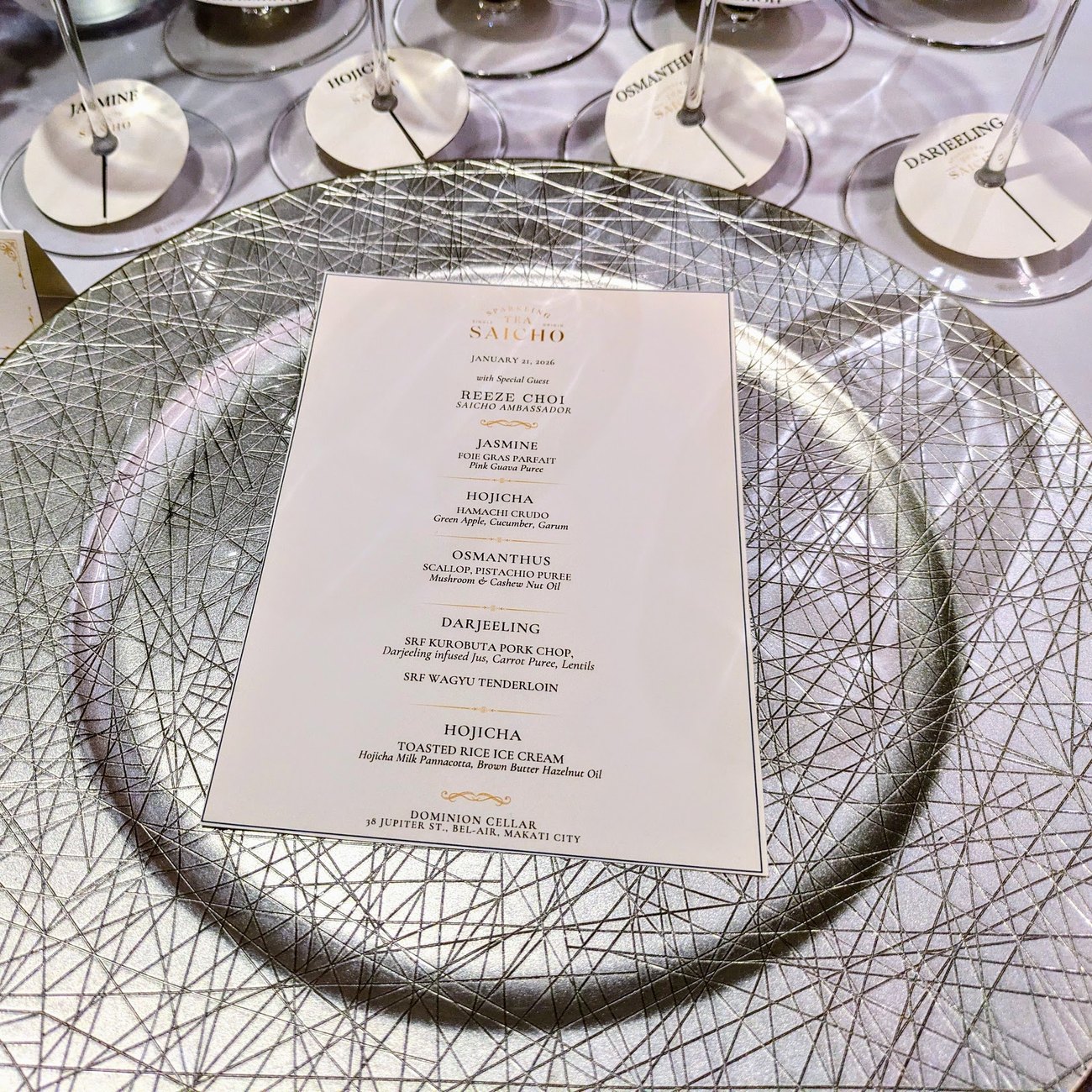
Four glasses stared at me, all squeaky clean and sparkling. But they weren’t champagne flutes. Each one had a label: Jasmine. Osmanthus. Hojicha. Darjeeling. I was confused. These were tea names. Since when was champagne made of leaves? Saicho Sparkling Tea. Not champagne. Not wine. Tea. We had no idea what we were in for.
The table was set beautifully, and the plates that followed were just as deliberate—gorgeous, yes, but thoughtful in a way that felt effortless, plated with enough care that you noticed the intention but restrained enough that the food knew its place. It was there to shine light on the tea we thought was champagne.
It turned out that one of the men from earlier was the sommelier. Even with a microphone in hand, Reeze Choi introduced himself so quietly you could have missed it—not because I couldn’t hear him but because he offered no fanfare, no credentials upfront, just his name. Then he started talking, generously and patiently, about what a drink can hold when it’s given the same care we usually reserve for wine. He shared how he began his journey, how years ago, while working on the floor, he noticed that guests who didn’t like alcoholic beverages would ask for the same alternatives again and again: juice, soft drinks, coffee, tea—none of which made sense next to carbonara or pizza. It didn’t work, he said. What we were about to drink was different.
Sometime in between, I learned how Saicho came to be: a love story in chemistry. Charlie and Natalie, two postgraduate students taking up Food Science, met in a lab. Natalie loved tea, grew up with it in Hong Kong, understood pairing it with food the way others understood wine. But she was allergic to alcohol. Charlie did what I hope any scientist in love would do—use his brain to get to her heart. They spent two years figuring out how to make tea that could match the experience of wine pairing. He wanted so badly to ensure that she wouldn’t have to miss out on the joy. Through their labor of love, the rest was history.
The first sparkling tea to be served was jasmine. Before the sip, before the taste, once my lips touched the glass, I already smelled jasmine and was immediately transported to warm summer evenings in Seville, walking past orange trees with their blossoms perfuming the air. Years later, the closest thing I ever found to that feeling was Jasmin des Anges, hidden in some forgotten corner of an airport. This was gentler than that. Less insistent. But just as transporting.
I died before I could hear Reeze finish explaining how it was made, not brewed with just flowers but layered again over tea leaves—four times, sometimes nine—the flowers absorbing into the leaf slowly. You can’t rush it, he said. The way he said you can’t rush it told me everything.
We were then served the foie gras parfait with pink guava. Reeze explained that foie gras is often paired with sweet wine in French cuisine, not to mask it but to soften texture and create harmony, and here the jasmine did exactly that. It didn’t sweeten the foie gras. It rounded it. I found myself talking through the plate almost without realizing it, out loud, to no one in particular—the foie gras first, mousse-light, the taste of cream cheese intertwining, bittersweet pink guava making me salivate, the crunch of pink peppercorn, complemented by the bread underneath for texture, saltiness threading through everything, keeping it grounded. I didn’t plan to narrate each bite out loud, but I just couldn’t stop noticing.
By then I knew that I needed to speak to him after the tasting. The teacher in me recognized something—the way I do when I write little notes on my students’ work upon seeing brilliance that needs acknowledgment and celebration.
This Advanced Sommelier and WSET-certified educator, at only thirty-eight, must have been alive for at least two thousand years with the sharpness of his senses, his gravitas, and wisdom. Nothing else apart from his hard work and genius logically explains his placing third at the 2023 ASI Best Sommelier of the World competition in Paris, or his being the first Chinese representative to reach the global finals podium.
In the wine world, credentials like these are not decorative. They are won by attrition, earned through systems designed to outlast most people who enter them. But that night, none of it needed saying. Despite being recently named Best Sommelier of Asia & Pacific in 2025, what stayed with me was how generously he shared what drinks can hold, how joy, memory, and history live inside a glass if you know how to listen.
Joy, memory, and history live inside a glass if you know how to listen.
He then put his history teacher hat on and spoke about how the tea was cultivated in the Fujian mountains telling us the story of Saicho, the Japanese monk who brought tea from China to Japan and the reason for the company’s name. I don’t remember every detail now, only that it stayed with me the way myths do—half-remembered but felt.
I didn’t tell him this, but somewhere during that story I started wondering: this kind of attunement doesn’t come from training alone. It feels learned over lifetimes, whether one believes in that sort of thing or not. Could he once have been one of those Trappist monks who brewed beer not for indulgence, but because brewing made water safer and the whole thing became nourishing, communal? Or, on a more indulgent day, been Dionysus himself, reborn with an excellent palate, minus the chaos of the god’s infamous drunken revelry? Regardless, in present times, he just happens to be making his own wine now in Hiroshima, through a collaboration with a local vineyard.
By then, my wine glass was empty. Having finished two glasses of jasmine tea, my mind returned to my body, which happened to be seated beside my childhood friend. I was seven and she was barely one when we first met in Boston. Back in college, she won Harvard’s Hoopes Prize for analyzing 200,000 artworks to redefine gender in art history. “This tea is shockingly complex.” She had finally broken her silence. I looked at her, bewildered and amused at how delighted her introverted self was, experiencing our non-alcoholic, non-champagne evening. As if the work she’d done measuring complexity across centuries of data, or the piano pieces she worked hard to learn yet played so effortlessly, weren’t already training her eye and ear for exactly this. She knew what she was tasting.
The next tea served was osmanthus, based on oolong. Reeze explained: semi-oxidized, the leaves shaken just enough that the edges turned brown while the center stayed green—complexity by restraint—and the osmanthus flowers layered over the tea for forty-eight hours. For a new release, surprisingly, the first hundred cases sold out immediately.
Served along with it were scallops with pistachio purée, mushroom, and cashew nut oil. With this shellfish and tea pairing, everything unfolded in one long breath: a faint bitterness from the tea first, then a gentler sweetness, citrus keeping it linear, the scallop’s own sweetness surfacing, acidity lingering just long enough to notice before disappearing.
Of course, as Reeze was narrating the process, I was googling to check if I was right about osmanthus symbolizing nobility in China. I was. Its flowering branches were gifted to civil servants who passed their exams. This fascination with Chinese culture began because acupuncture had done wonders for me. Next thing I knew, I was reading up on Traditional Chinese Medicine, learning Tai Chi, accidentally getting targeted by those addicting Chinese drama reels. And yes, those reels featured impossibly handsome actors playing scholars receiving osmanthus branches, which is probably why I remembered that detail at all. Maybe that’s also why I could recognize the kind of knowledge Reeze carried: not just learned, but lived. When ancient practices change your body, you start paying attention to people who understand that kind of depth.
I drank water to cleanse my palate before tasting the tea again. The osmanthus pulled at something—a memory I couldn’t quite place at first. Then it came: Hong Kong, years ago, a tea whose name I never learned. And here it was again, layered over oolong, carbonated, paired with scallop. Some flavors follow you.
We progressed onto the third glass. This time it was hojicha, roasted Japanese green tea. Reeze talked about the roasting process: sun-exposed first, then roasted, giving it those nutty, toasted notes—the opposite of matcha, because matcha is shaded to preserve chlorophyll while hojicha is opened to the sun.
On the plate was hamachi crudo with green apple, cucumber, and garlic. The hamachi was clean, almost translucent. I expected brightness, citrus, maybe sharp acidity. Instead there was umami—deep, savory, grounded. The garlic tasted sweet, not caramelized-sweet but naturally sweet, coaxed into softness. The fish brought its own salt. The texture—slippery, yielding—did as much work as the flavor. Reeze mentioned the tea came from sustainable farms using a grass-tea integrated system, recycling bamboo and silver grass back into the soil. Nothing wasted. Everything circular.
Last but not least, the final tea was served: Darjeeling. Grown at two thousand meters in the Himalayan foothills, it was much like champagne, in a sense that origin and method matter. Reeze walked us through how it was partially oxidized, hovering between oolong and black tea, with notes of muscat grape, ginger, wood spice, orange peel. Someone at the table said it tasted like roasted sesame and rice. Another quietly ranked it second, right after the jasmine. Then the penultimate dish was served: Kurobuta pork chop with Darjeeling-infused jus, carrot purée, and lentils.
One bite pulled me straight back to Spain: to Sanlúcar de Barrameda, at the mouth of the river Guadalquivir, where Magellan once set out in search of spices, a journey that would eventually, unintentionally, lead him to the Philippines. A place where five hundred and seven years later, my tongue was kissed by the very flavors that once set that search in motion.
We thought it was finally over. The pork already felt like an exclamation point when another dish arrived: SRF Wagyu.
Even the wagyu tenderloin worked cold; it sat there longer than intended as I meticulously narrated the experience into a voice recording, much to the amusement of my table, mildly losing my mind over the evening, my attention clearly elsewhere. I take the worst pictures of food, so I make voice notes instead, because capturing the essence of taste itself matters to the writer in me. The horseradish, made from scratch, was sharp on its own; the béarnaise along with the little chunks of bone marrow melting on my tongue unforgettable and indulgent; the pickled onion sealing it. Pure unhinged joy in each bite.
In shock, I turned to my seatmate, twenty years my junior. “Are the Oscars the highest awards or something?” I asked. “Because this bite just won an Oscar.”
And yes, I gave that bite an Oscar. Michelin didn’t even occur to me—because by then, the experience was so new, even if it was literally about food. It had transcended its own identity. No other notes were needed. The silence, heads bobbing slowly around the table, said we all agreed.
By then, we’d stopped wondering silently. There were too many unanswered questions, and being the teacher I was, I had no qualms about raising my hand to find answers. I started interrogating the waitress. Earlier, with the pork, I had surprised myself by asking a question I hadn’t planned to ask: Is there cúrcuma in this? I found myself teleporting through my tastebuds. I was back in Sanlúcar, in the 18th century marketplace standing beside my Spanish grandpa-of-a-landlord and my favorite butchers, learning the secret spices of a dish whose name I still can’t quite remember. The server smiled and said, almost proudly, “Oh, the chef is Spanish. The ingredients are from Spain.”
Bingo.
I didn’t know the chef’s name. I didn’t have a plan. I just knew I had to say thank you. So, I ran—actually ran—to the kitchen, scanning faces for someone who looked Spanish, trusting instinct more than logic. That’s how I met Carlos Garcia. Not because I was looking for him. But because the food had already found me.
After returning from my little escapade, I waited in line to be able to say goodbye to Reeze. Beside him was the same man from earlier, this time introducing himself as Reeze’s bodyguard. They both laughed. His name was Federico Bogna. Saicho’s reason for being in Manila. Funny how neither of them needed titles. The experience said everything.
I told them how happy I was about the evening; how precious it is to experience something that makes you pay attention to being alive. It reminded me of the Iranian film Taste of Cherry, where a man decides to die but stops because of mulberries—their taste, unexpected and small, enough to make him reconsider. That’s what the night felt like. Tea we thought was champagne, food that tasted like memory, a sommelier who made drinks feel like hymns. Small things. Enough to make you want to stay.
And in true Filipino fashion, after many lingering goodbyes, I went back to Reeze as everyone wished him well for his next competition. With the same deep pride I felt writing two-page college recommendation letters for my students, I congratulated him with conviction. Somewhere in that last goodbye, it became clear: what award? The next one didn’t matter. You can’t award someone who has become the criteria.
You can’t award someone who has become the criteria.
Dominion Cellar is the kind of place where you expect to get drunk. I left sober. Drunk with joy.